On Portable Architecture: the Poetics of Cart

Portable architecture is a silent master—restless, lightweight, yet precise and rigorous. These striking structures host numerous, unprecedented functions, yet fit in your hands. They arrive without proclamation, unfold without monumentality, and disappear without residue.
The cart—humble, mobile, contingent—becomes both instrument and architecture, a minimal chassis upon which the city’s latent programs briefly crystallize.
What follows is not an addition but a deepening: a series of embedded instances where the cart expands from typology into method, from object into cultural argument.
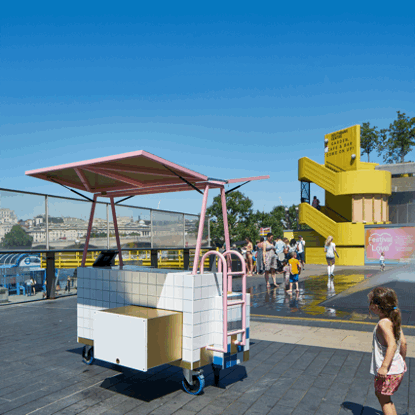
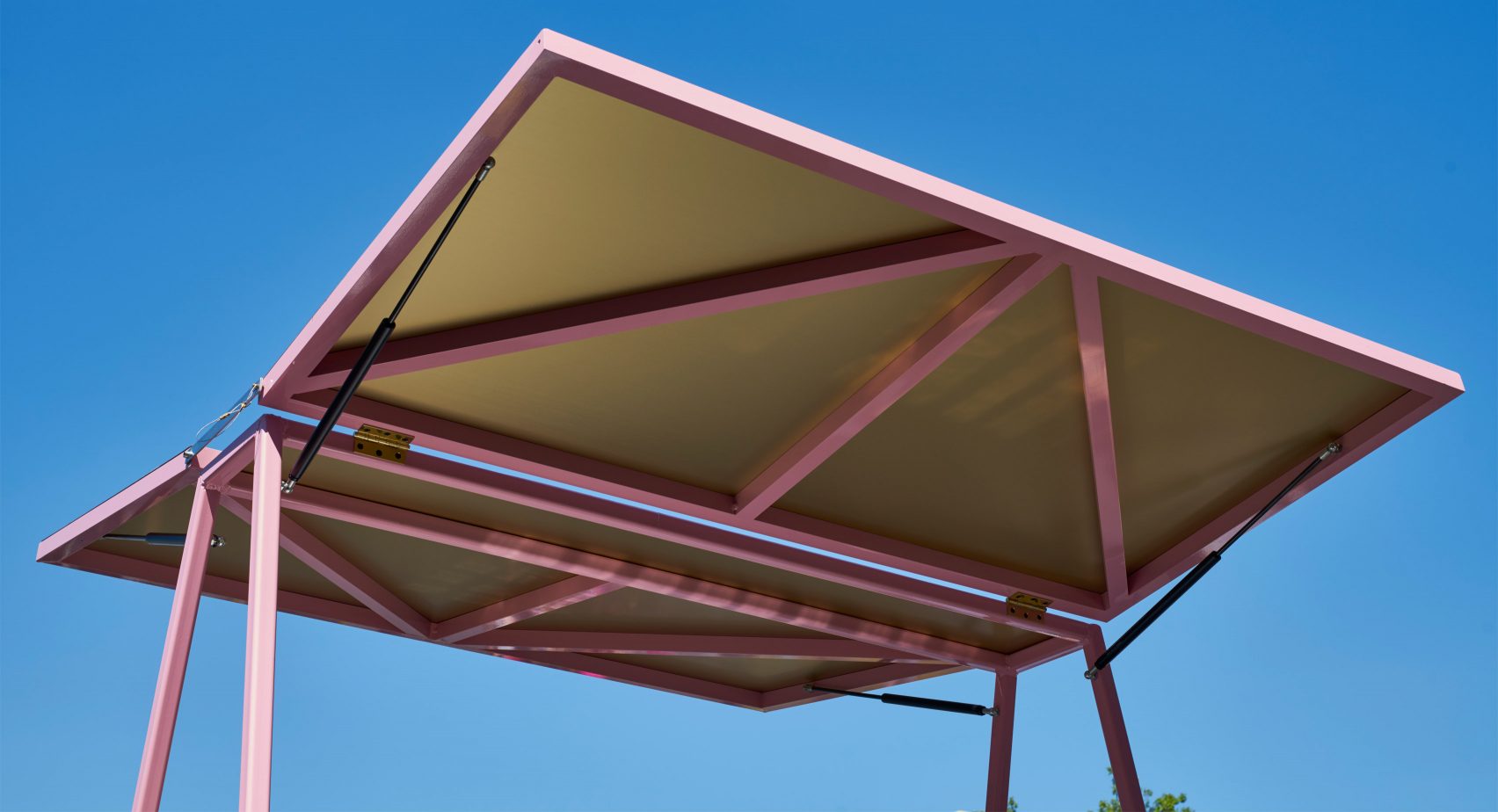
A telling manifestation of this ethos appears in Mobile Shop by How About Studio. Conceived as a wheeled micro-architecture for London’s Southbank, it collapses the distinction between retail, performance, and social condenser. Its bright, almost playful articulation masks a deeper disciplinary provocation: the shop is no longer a destination but a transient encounter. It parasitizes pedestrian flows, inserting commerce into the rhythms of leisure and festival. What it contributes to the discourse is not merely mobility, but a recalibration of publicness—architecture that does not anchor space but briefly intensifies it.

To speak of the cart is to speak of architecture before permanence: before foundations, before ownership, before the illusion of stability.
It is architecture as event, as negotiation, as tactic.
In this sense, the cart aligns less with the canonical lineage of buildings and more with the ephemeral practices described by Bernard Tschumi, where space is activated through use rather than fixed form. The cart does not wait for occupation; it produces it.
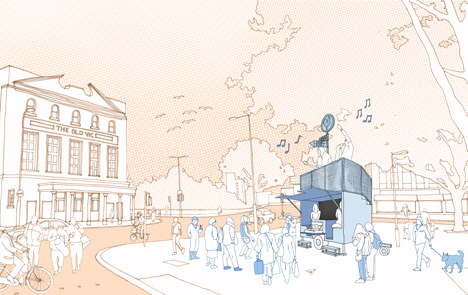
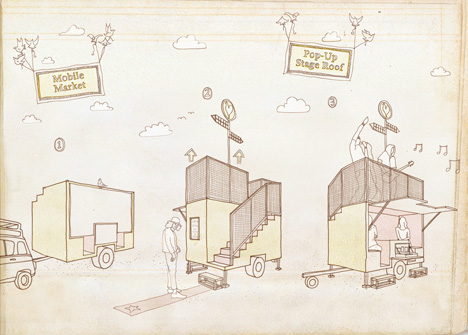
This logic is radicalized in Roaming Market by Aberrant Architecture, where the cart becomes an urban strategy rather than a singular object. A constellation of travelling blue, folly-like structures disperses and reassembles, forming informal performance venues inspired by sixteenth-century market stalls and Roman fortune tellers—configurations that resist zoning, permanence, and control.
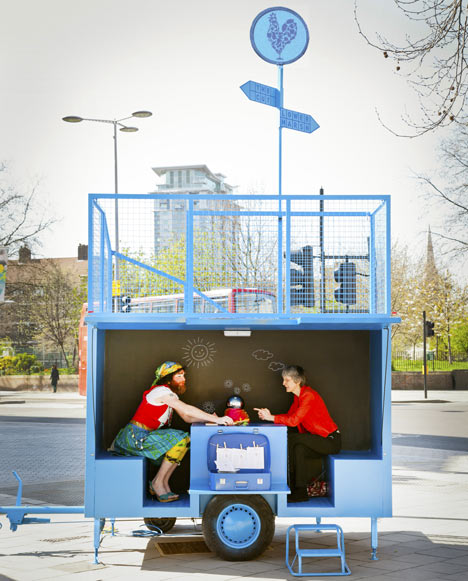
It is an architecture of distribution—economically, spatially, and socially. The project exposes how mobility can challenge the centralization of culture, redistributing agency to artists often excluded from formal institutions. Here, the cart is not only an object but a networked condition—an urbanism in motion.
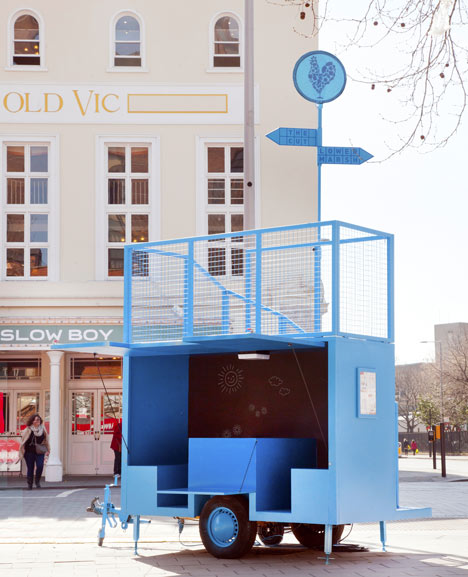
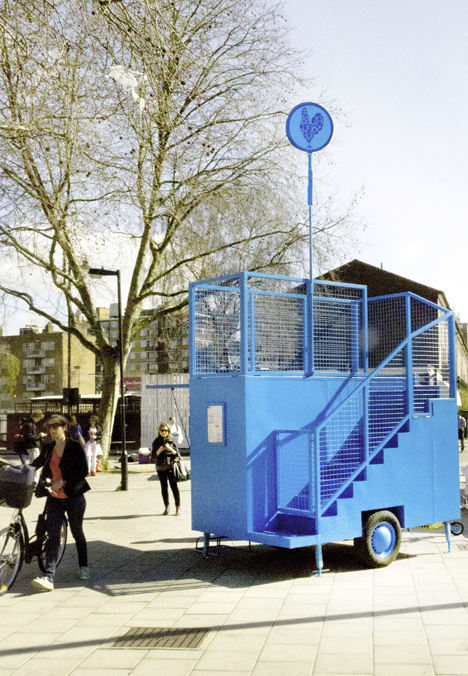
The poetics of the cart reside in constraint. Limited surface, reduced weight, and constant motion generate a design intelligence that is both ruthless and inventive. A street vendor’s cart, a travelling library, a protest kiosk—each condenses infrastructure into a compact, deployable unit, resonating with the broader refusal of architectural determinism found in Cedric Price, while extending it into the ecological domain.
The cart is no longer simply adaptable—it is regenerative. Its modularity does not merely anticipate change; it cultivates it.
A further expansion of this ethos emerges in Sementeira Ambulante by LIMIT architecture studio, a mobile public installation linking local food production with broader urban engagement.


This modular greenhouse extends the presence of the farm into the city, originating from site visits and discussions with the farm’s community prior to the design phase. Inspired by the message “Who sows illusions, reaps disappointments,” it emphasizes ecological awareness and collective participation throughout Braga. Eight modular units, mounted on wheels, are constructed with lightweight aluminium frames, internal shelving for seed trays, translucent yellow polycarbonate panels, and a curved sheet-metal roof referencing traditional greenhouse typologies while enabling effective rainwater drainage.

The cart here is not reactive but propositional: it constructs publics around environmental awareness, translating agricultural labor into a shared urban pedagogy. Sementeira Ambulante serves deferred futures—those of biodiversity, food sovereignty, and collective stewardship. It reframes the cart as a vector of slow time, paradoxically moving in order to sustain what must grow.

Beginning from the assumption that nothing is fixed, the cart’s bricolage aesthetics—layered materials, improvised joints, hybrid programs—reveal a design intelligence embedded in use rather than representation.
It is a device of survival as much as invention.
Informal urbanism has long relied on such portable architectures to bridge gaps in planning, offering services where none are provided. These structures propose an architecture that can be packed, carried, and redeployed, challenging Vitruvian notions of firmness. In their place, adaptability becomes the primary virtue. Yona Friedman’s vision of mobile, user-determined structures resonates here: architecture not as object but as system, open to reconfiguration by its inhabitants.
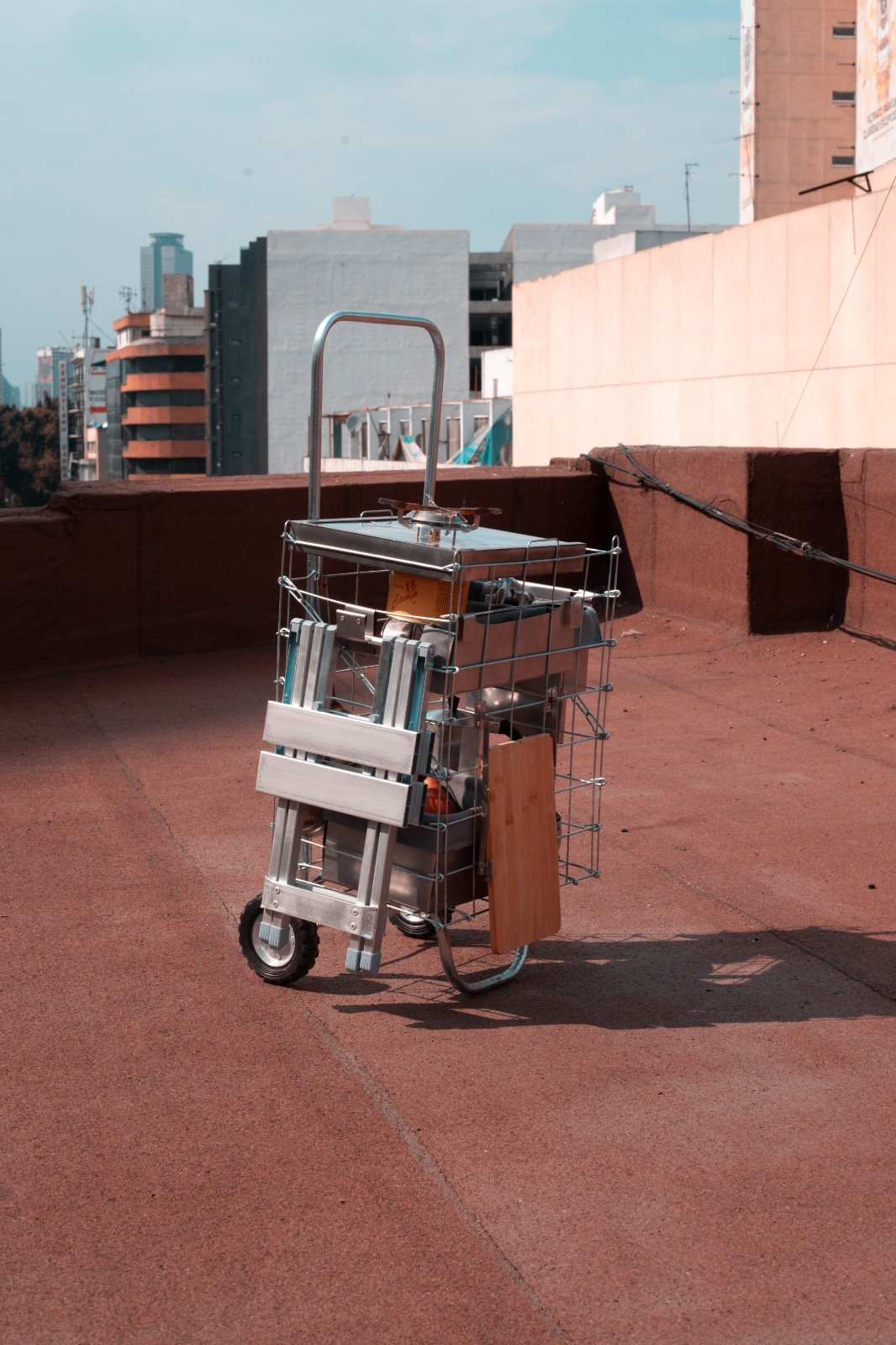
Through incremental modifications, repairs, and appropriations, the cart redefines authorship—destabilizing notions of excellence and completion, and replacing them with a distributed intelligence embedded in practice.
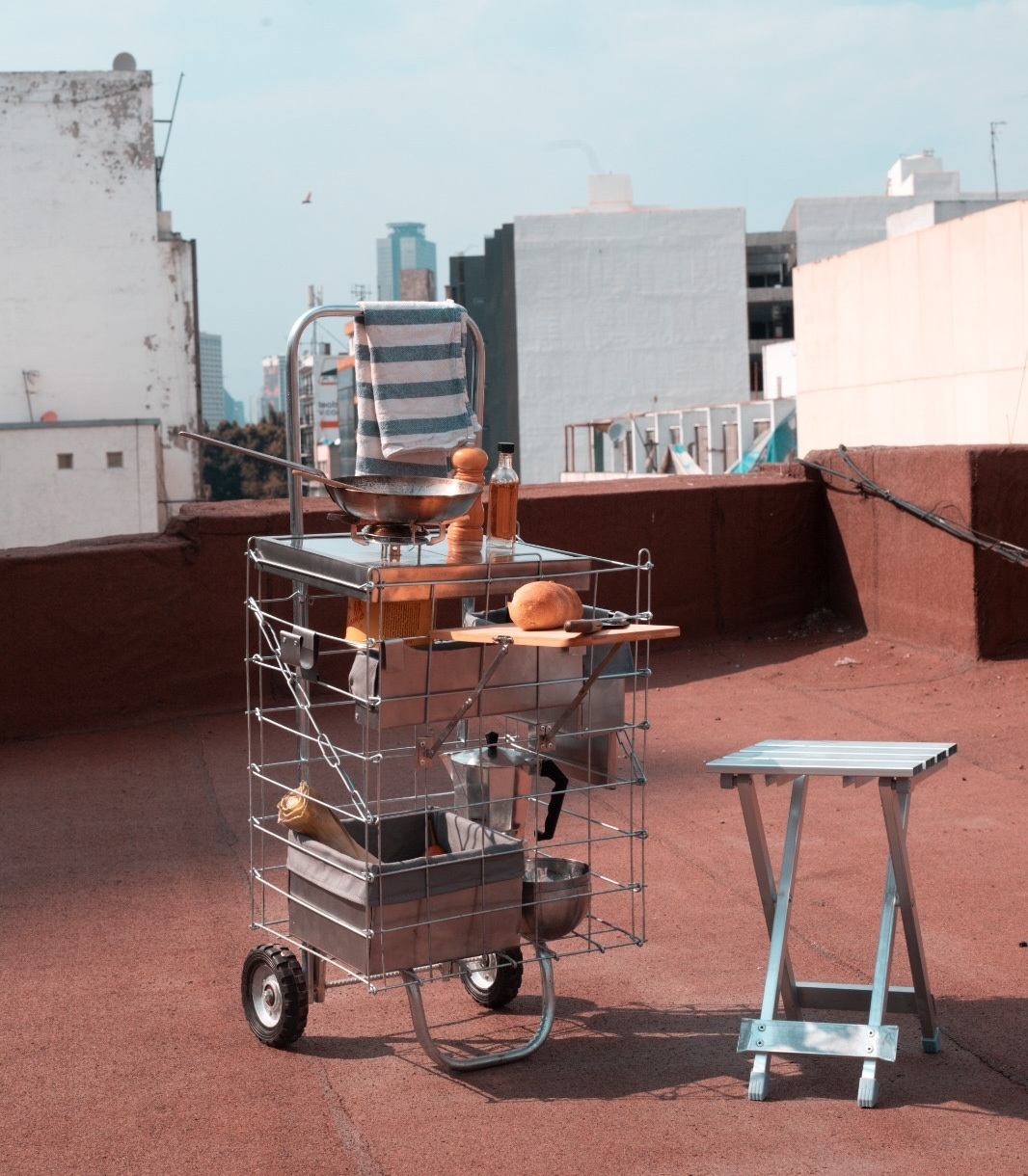
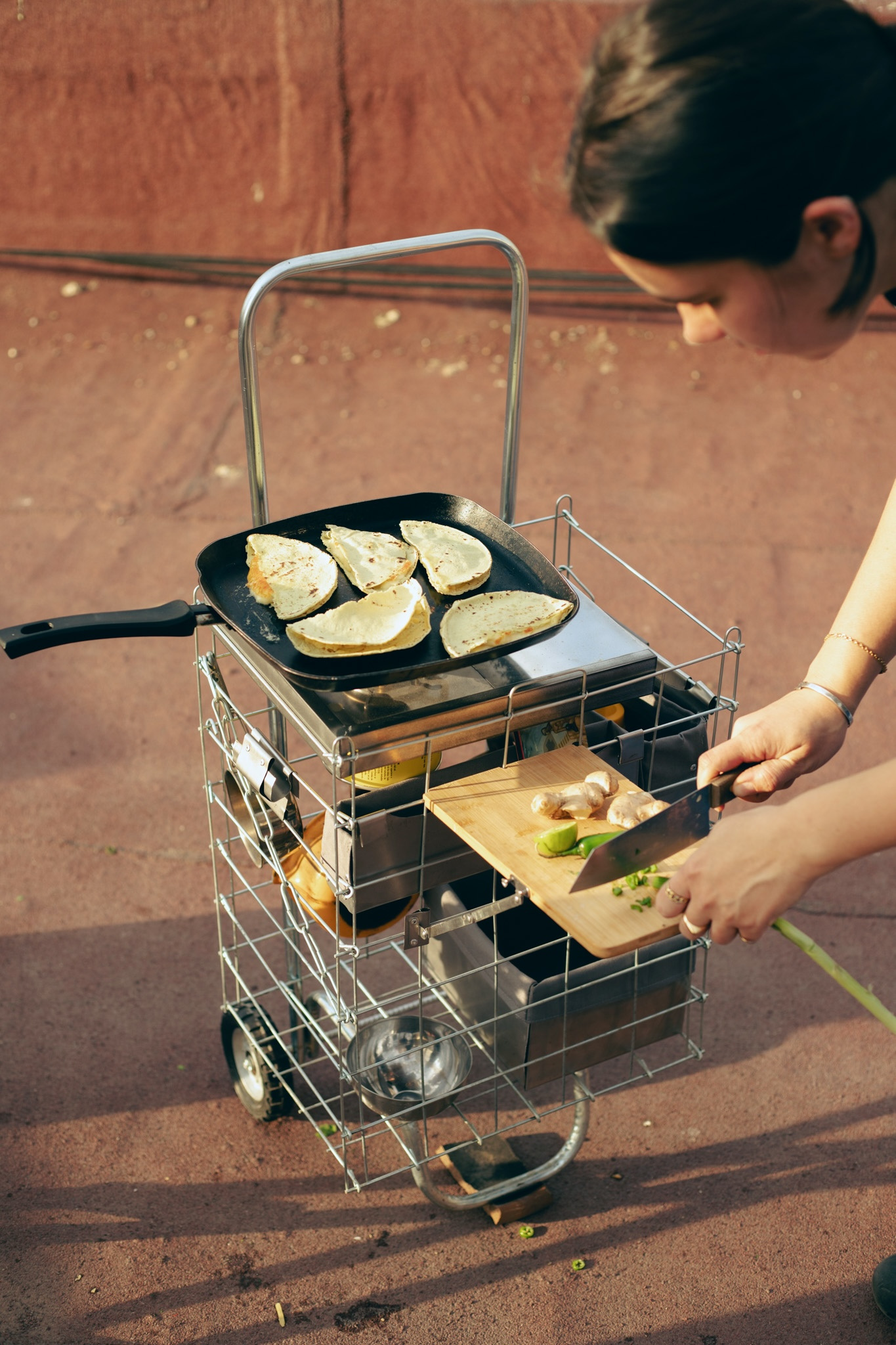
Echoing Friedman’s ambitions, where inhabitation is privileged over form, Carrito Kitchenette by Breanne Johnson in Mexico City reframes domesticity. Fitted into the ubiquitous metal trolley of everyday logistics, it reconstructs the rituals of cooking and eating within the exposed conditions of the street. Here, the cart gently domesticates public space, producing fleeting interiors without walls. The act of cooking—typically confined to the private sphere—spills outward, carrying with it the sensorial and social density of the home.
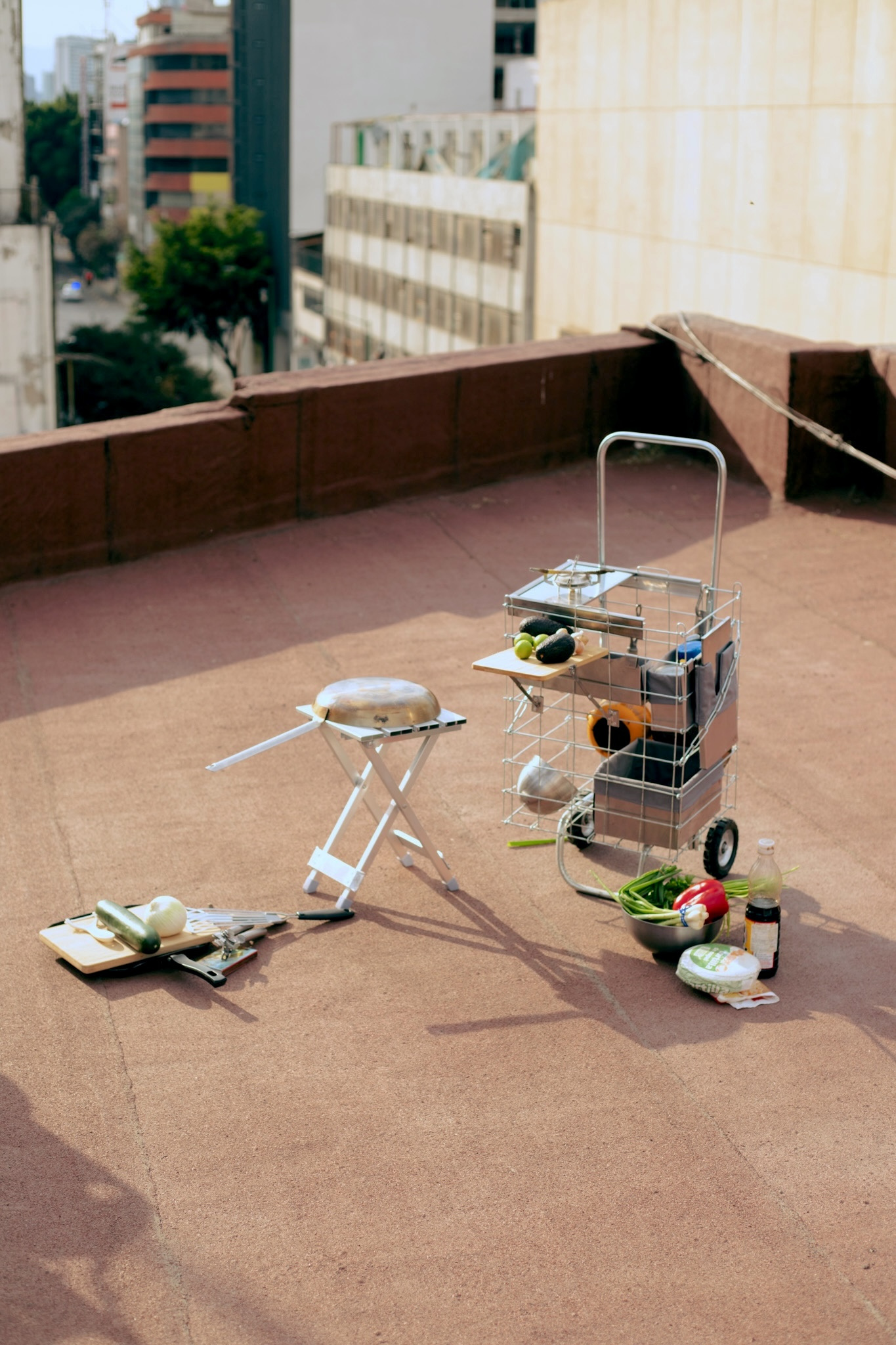
What this project contributes is not merely a programmatic hybrid, but a phenomenological recalibration. The cart becomes a device for re-synchronizing bodies and environments, foregrounding care, nourishment, and presence in spaces often governed by speed and anonymity. Johnson’s intervention suggests that the radical potential of portable architecture may lie not in spectacle, but in the reintroduction of ritual—small, repeated acts that recondition how space is felt and shared. The cart becomes, in this sense, a micro-domestic infrastructure, dissolving the binary between interior and exterior, between private ritual and public life.

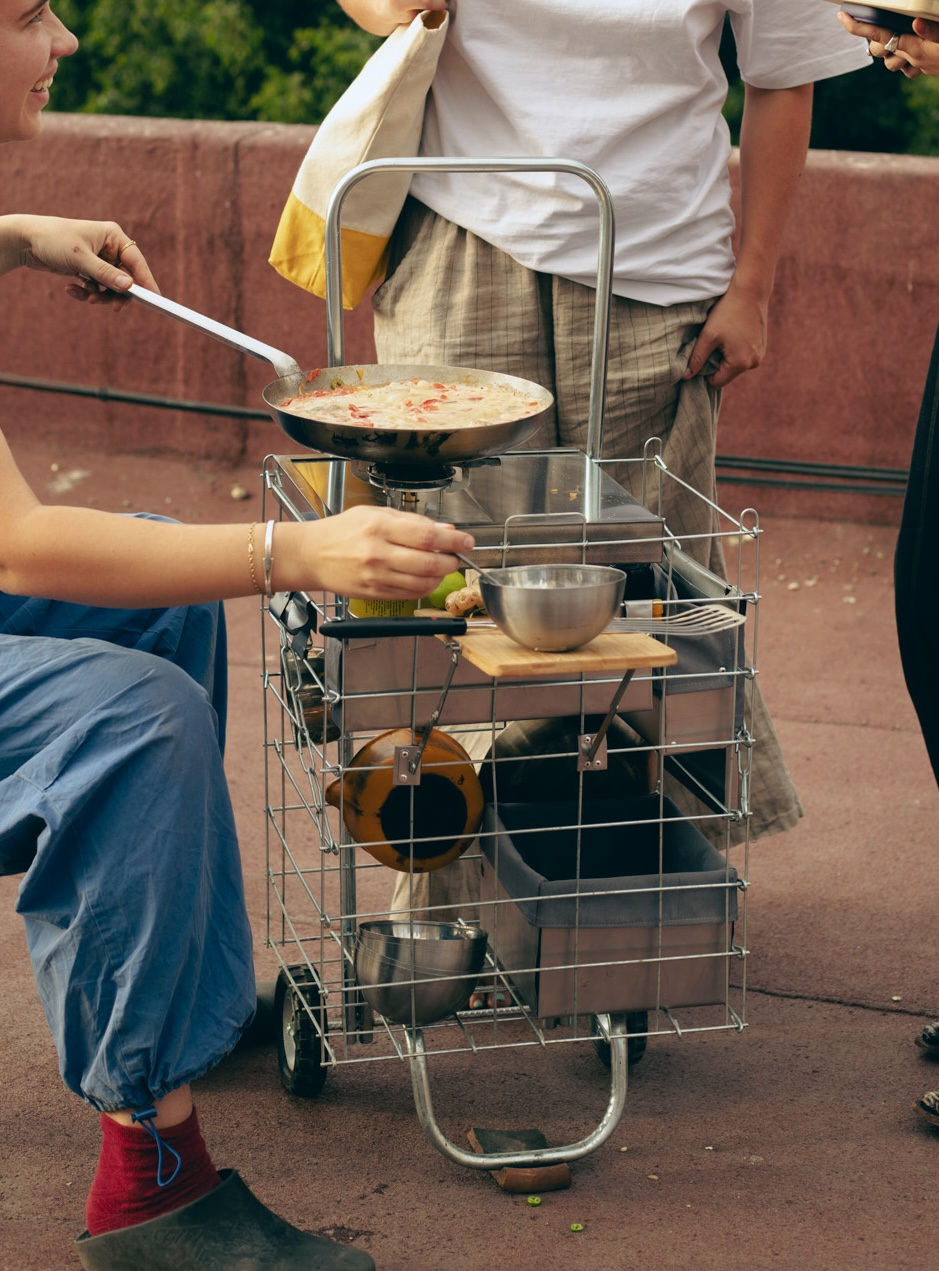
The cart thus emerges as more than an object; it becomes a methodology for redistributing spatial agency. Its lightness, often born of necessity, enables it to infiltrate systems that resist permanence. Its elegance is inseparable from precarity—its lightness not a stylistic choice, but a structural condition imposed by instability. By extending the lineage of portable architecture into a contemporary condition, the cart introduces urgency: it is not merely a curated artifact, but a lived infrastructure.

Emerging from the fragility of human life, the mobile printing press by John Conway introduces a third dimension: mortality. Developed in collaboration with Space Forms, this wheeled apparatus navigates hospital corridors, embedding itself seamlessly within the choreography of care. Its form borrows from bar carts, medical trolleys, and traditional presses, achieving a careful ambiguity—it is at once tool, furniture, and companion. Yet its true architecture lies in what it produces: prints that capture the words of patients nearing death.
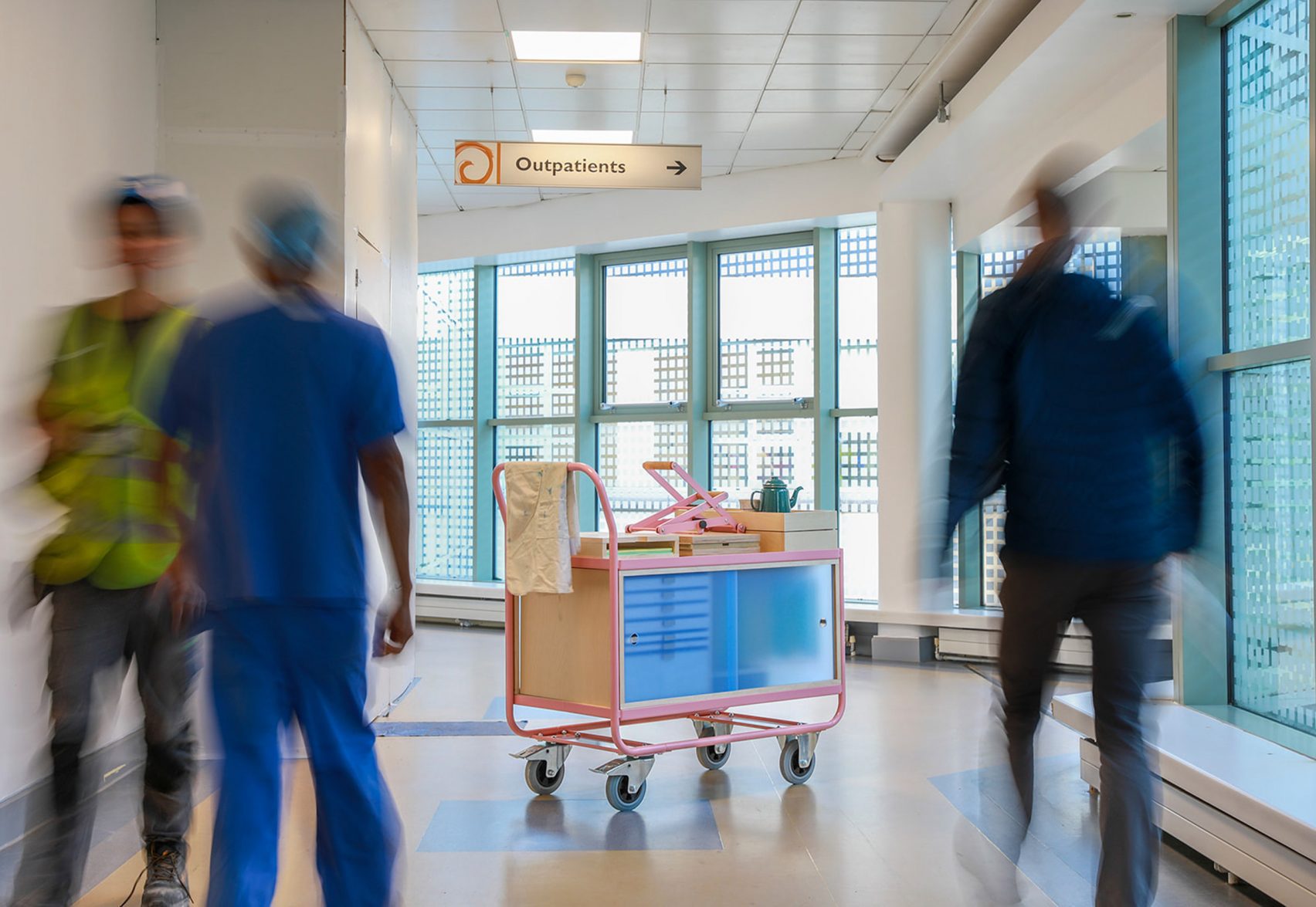
Here, the cart becomes a vessel for the intangible. It structures a space of expression at the threshold of life, translating ephemeral thoughts into material traces. Unlike the marketplace cart or the mobile shop, its economy is not transactional but existential. What it offers is neither product nor service in the conventional sense, but a mediated encounter between language and finitude.
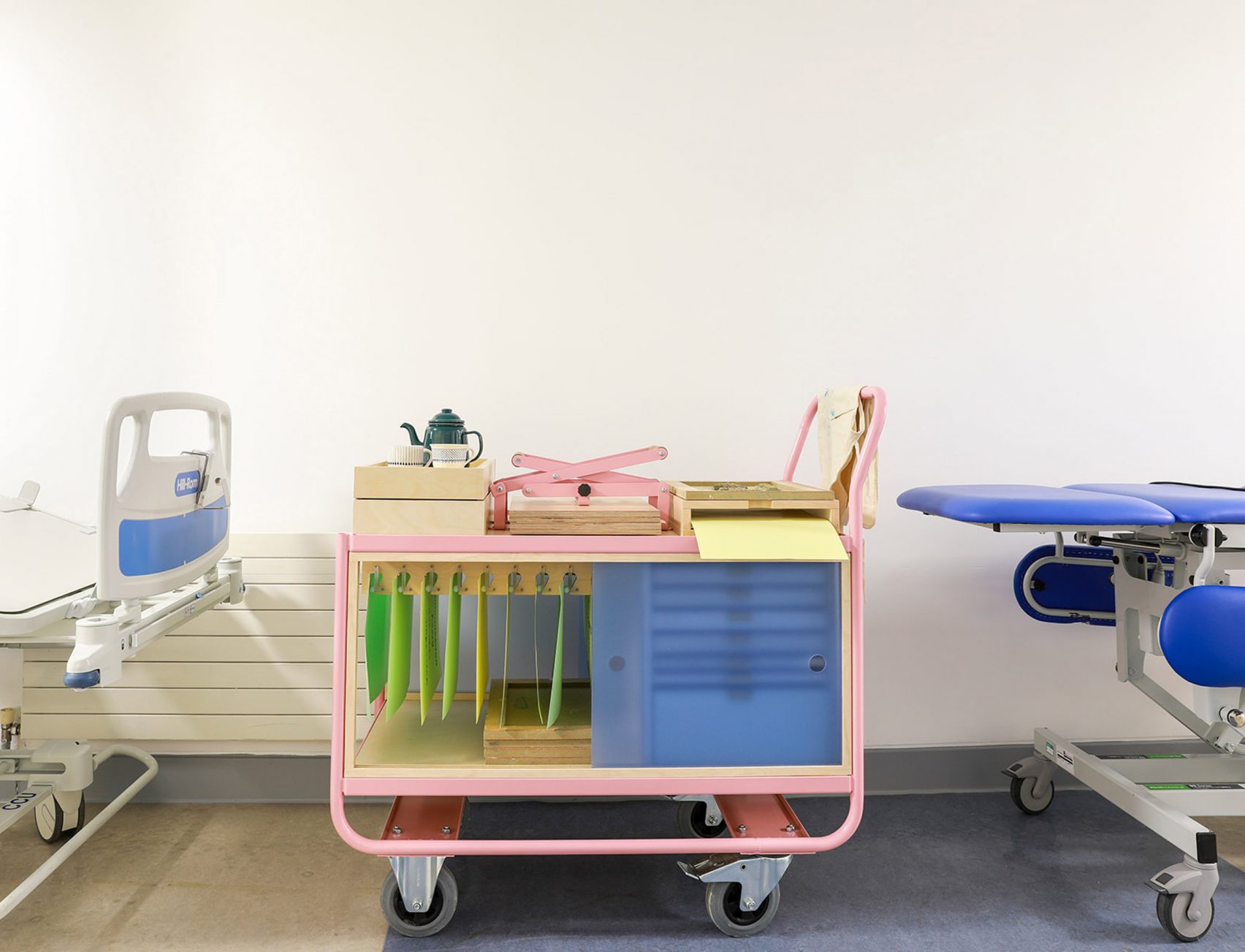
What Conway’s cart brings to the discourse is a profound expansion of programmatic scope. It demonstrates that portable architecture can engage not only with commerce, education, or sociality, but with the most delicate dimensions of human experience. The cart here is not merely adaptive—it is empathetic. It frames a space where authorship dissolves into testimony, where architecture facilitates rather than guides expression.
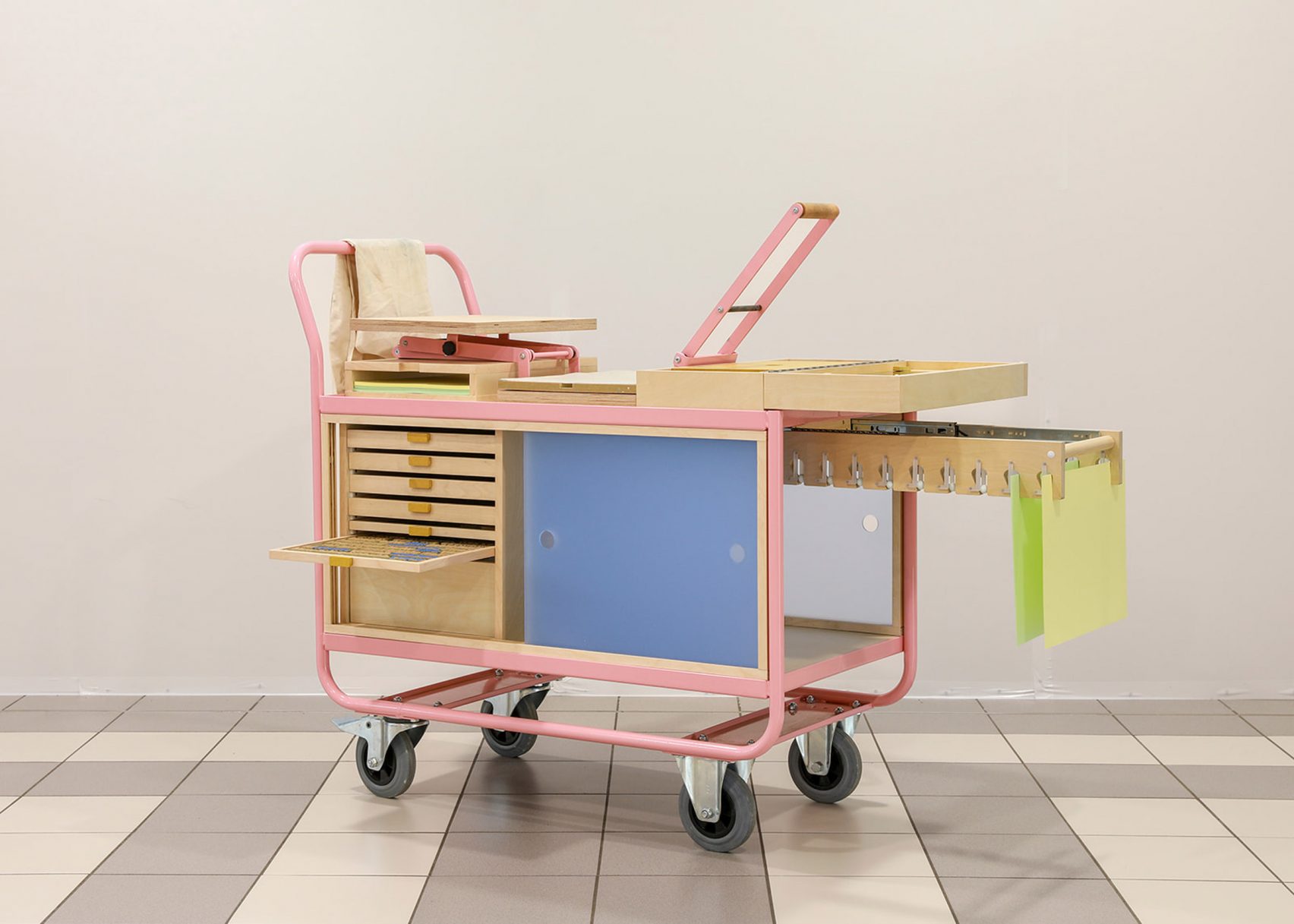
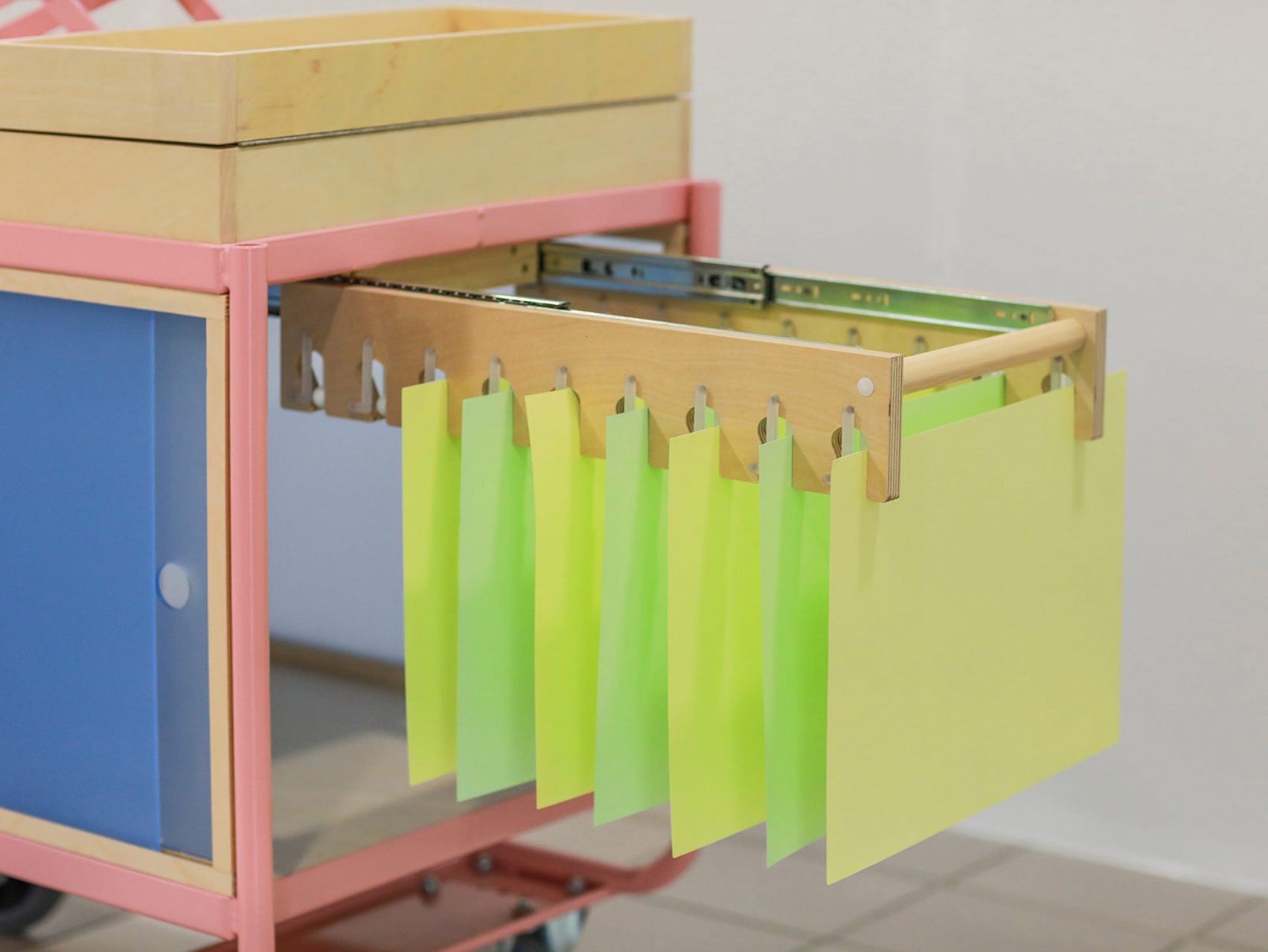
Within its modest frame, the cart constructs a microcosm.
It organizes goods, bodies, and interactions into a coherent spatial narrative. It frames encounters, mediates exchanges, and choreographs movement. Whether in the curated vibrancy of festival installations, the strategic dispersal of roaming markets, the improvised ingenuity of everyday street apparatuses, or within the secluded ecosystem of a hospital, the cart reveals that architecture’s essence may not lie in permanence or scale, but in its capacity to structure relationships—temporarily, precisely, and with consequence.
To consider the cart as architecture is to accept a shift in values: from monument to mechanism, from stability to flux, from authorship to adaptation.
It is to recognize that the future of architecture may not be anchored to the ground, but carried through the streets—folded, wheeled, and perpetually in motion.
Bibliography
Friedman, Y. (1975) Toward a Scientific Architecture. Cambridge, MA: MIT Press.
Mathews, S. (2007) From Agit-Prop to Free Space: The Architecture of Cedric Price. London: Black Dog Publishing.
Simone, A. (2004) For the City Yet to Come: Changing African Life in Four Cities. Durham: Duke University Press.
Tschumi, B. (1996) Architecture and Disjunction. Cambridge, MA: MIT Press.